If you manage a warehouse, housing society, corporate office, or industrial plant in Pakistan, controlling vehicle speed on your property isn’t optional — it’s essential for pedestrian safety, asset protection, and liability reduction. But when it comes to choosing a traffic-calming solution, most facility managers get stuck on one question: should you install speed breakers or rumble strips?
While both are used to slow down vehicles, they work differently, serve different purposes, and are suited to different environments. In this guide, we’ll break down the differences so you can choose the right solution for your facility.
What Are Speed Breakers?
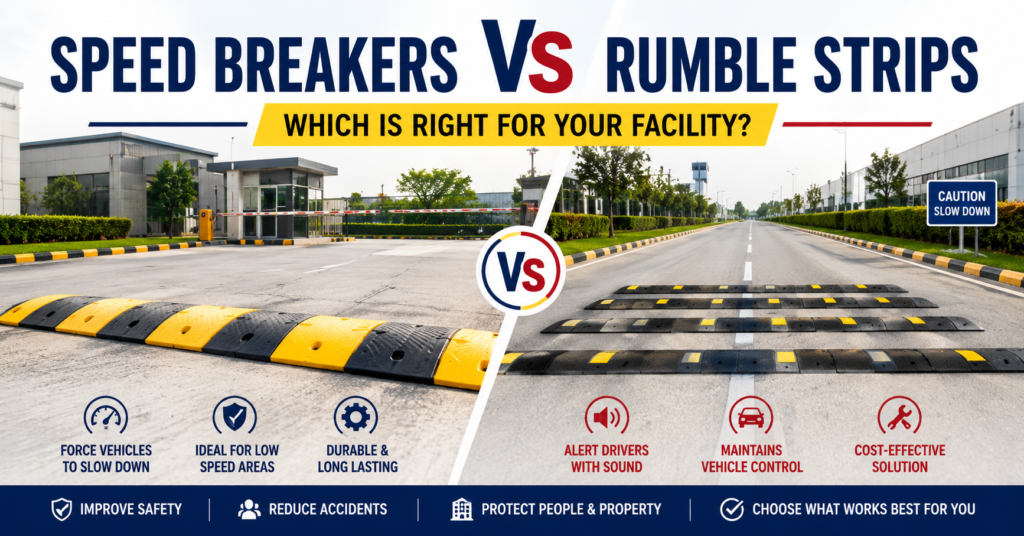
Speed breakers (also called speed bumps or speed humps) are raised sections installed across a road or driveway. They force drivers to slow down significantly — usually to 5-15 km/h — because failing to do so causes discomfort or vehicle damage.
Common materials: Rubber, asphalt, or concrete Typical height: 5-10 cm Best for: Areas requiring drivers to come to a near-stop, such as pedestrian crossings, school zones, and parking lot entrances
Techno-Inn’s rubber speed breakers are a popular choice because they’re durable, easy to install, and don’t require the structural changes that concrete breakers do.
What Are Rumble Strips?
Rumble strips are a series of shallow, closely spaced ridges cut or raised into the road surface. Unlike speed breakers, they don’t force a vehicle to slow down — they create noise and vibration inside the cabin to alert the driver, encouraging a natural reduction in speed.
Common materials: Thermoplastic, rubber, or milled asphalt Typical height: Under 2 cm Best for: Long approach roads, highway entry points, toll booths, and areas where gradual speed reduction is more appropriate than a hard stop
Key Differences at a Glance
| Factor | Speed Breakers | Rumble Strips |
| Function | Physically forces vehicle to slow down | Alerts driver through noise/vibration |
| Speed reduction | High (near-stop) | Moderate (gradual) |
| Best location | Parking lots, entry gates, residential zones | Highway approaches, long driveways, toll points |
| Noise level | Low (single impact) | Higher (continuous vibration while crossing) |
| Installation cost | Moderate to high | Generally lower |
| Vehicle wear | Higher impact on suspension if hit at speed | Minimal impact |
| Ideal for pedestrian zones | Yes | Not ideal — doesn’t fully stop vehicles |
Which One Should You Choose?
Choose Speed Breakers If:
- You have pedestrian crossings, school zones, or high foot-traffic areas
- Vehicles need to slow to a near-stop for safety
- You’re managing a housing society, hospital, or educational institution entrance
- You want a visible, physical deterrent against speeding
Choose Rumble Strips If:
- You have long approach roads before a checkpoint or gate
- Your goal is early driver alertness rather than a hard stop
- You’re managing an industrial plant, toll booth, or highway-adjacent facility
- You want a lower-maintenance, lower-impact solution
Use Both — A Layered Approach
Many high-security facilities in Pakistan — including government buildings, industrial plants, and gated communities — combine rumble strips at the outer perimeter with speed breakers near the final checkpoint. This creates a layered speed-control system: rumble strips alert drivers early, and speed breakers enforce compliance right before sensitive zones like gates, tyre killers, or road blockers.
This kind of layered design is especially common at facilities that also deploy road blockers and tyre killers for ultimate site security, where every meter of approach road plays a role in access control.
Why Traffic Calming Matters for Perimeter Security
Speed breakers and rumble strips aren’t just about comfort — they’re a critical part of your facility’s overall security posture. Slowing vehicles down before they reach checkpoints gives security personnel more time to react, reduces the risk of ramming attacks, and complements other perimeter security measures like under vehicle surveillance systems (UVSS) and boom barriers.
If you’re planning security for a new facility, traffic calming should be considered right alongside your complete building security plan.
Frequently Asked Questions
1. Can speed breakers damage vehicles? If installed correctly with proper height and slope, speed breakers shouldn’t cause damage at appropriate speeds. Poorly designed or oversized breakers, however, can affect vehicle suspension over time. This is why professional installation matters.
2. Are rumble strips effective on their own? Rumble strips are effective for alerting drivers, but they don’t force compliance. In high-security or pedestrian-heavy areas, they’re best paired with speed breakers or other physical barriers.
3. Which option is more cost-effective? Rumble strips are generally cheaper to install and maintain since they don’t require the same structural buildup as speed breakers. However, the right choice depends on your specific traffic-calming goals, not just budget.
4. Can these be installed on existing roads without major construction? Yes. Techno-Inn’s rubber speed breakers and modular rumble strips are designed for retrofit installation on existing asphalt or concrete surfaces, minimizing downtime.
5. Do housing societies in Pakistan need both speed breakers and rumble strips? Larger housing societies with long internal roads often benefit from both — rumble strips at entry points and speed breakers near parks, schools, and community centers where pedestrian activity is highest.
6. How often do speed breakers and rumble strips need maintenance? Rubber speed breakers typically last several years with minimal upkeep, while surface-applied rumble strips may need reapplication every 1-2 years depending on traffic volume and weather exposure.
Get the Right Traffic-Calming Solution for Your Facility
Choosing between speed breakers and rumble strips doesn’t have to be a guessing game. Techno-Inn’s team can assess your facility’s layout, traffic patterns, and security requirements to recommend — and install — the right solution.
Get a Free Site Survey & Consultancy and let our engineers design a traffic-calming and perimeter security plan tailored to your property.