Warehouses are a critical part of modern business operations. They store valuable products, raw materials, machinery, equipment, and important inventory. However, because warehouses often cover large areas and handle frequent movement of employees, visitors, trucks, and delivery vehicles, they can also become vulnerable to theft, unauthorized entry, and vehicle-related security risks.
A single weak entry point, an unmonitored loading area, or poor vehicle access control can create serious security problems. This is why modern warehouses need more than traditional locks and security guards.
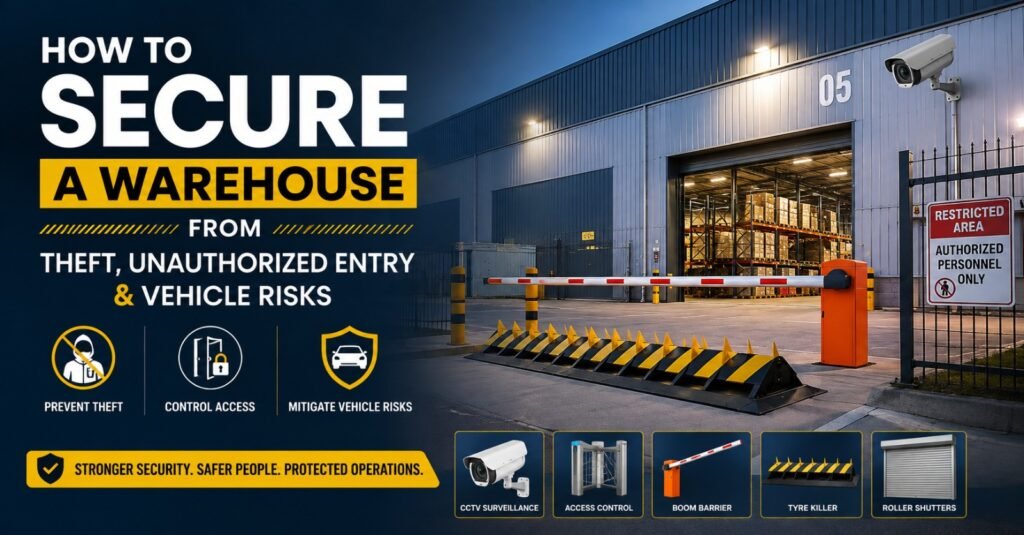
A complete warehouse security system combines CCTV surveillance, access control, vehicle barriers, perimeter protection, and intelligent monitoring to create multiple layers of security.
In this guide, we will explain how businesses can secure warehouses from theft, control unauthorized access, and manage vehicle risks effectively.
Why Warehouse Security Is Important
Warehouses contain valuable assets that can attract both internal and external security threats.
Common warehouse security risks include:
- Theft of inventory or equipment
- Unauthorized employee access
- Intruders entering restricted areas
- Unverified delivery vehicles
- Forced vehicle entry
- Theft during loading and unloading
- CCTV blind spots
- Unsecured emergency or side doors
- Vehicle accidents at loading areas
- Unauthorized movement after working hours
Depending only on security guards can leave several areas vulnerable. A modern security strategy should combine people, procedures, and technology.
1. Install CCTV Surveillance Across Critical Areas
CCTV is one of the most important elements of warehouse security.
Modern surveillance cameras allow security teams to monitor warehouse activity continuously and maintain video records of important incidents.
Cameras should be strategically installed rather than simply placed wherever space is available.
Important Areas for CCTV Coverage
Security cameras should monitor:
- Main entrances and exits
- Loading docks
- Warehouse aisles
- Inventory storage zones
- Dispatch areas
- Parking areas
- Vehicle gates
- Emergency exits
- Perimeter fencing
- High-value storage rooms
The goal is to minimize blind spots and ensure that important movements can be reviewed when required.
Modern CCTV systems can also include features such as motion detection, night vision, remote monitoring, and intelligent video analytics.
2. Control Employee and Visitor Entry with Access Control
Not every person entering a warehouse should have access to every area.
Traditional keys provide limited control because they can be copied, lost, or shared. An access control system provides a more secure method of managing who can enter restricted locations.
Depending on security requirements, warehouses can use:
- RFID cards
- Biometric fingerprint readers
- Facial recognition systems
- PIN-based access
- Smart access cards
For example, warehouse workers may be allowed into general storage areas while only supervisors can access high-value inventory rooms.
Access control also creates digital records showing who entered a specific area and when.
This makes warehouse security easier to manage and improves accountability.
3. Secure Vehicle Entry Points
Warehouses often receive dozens or even hundreds of vehicles every day.
Delivery trucks, staff vehicles, supplier vehicles, forklifts, and logistics fleets can create major security challenges if vehicle entry is not properly controlled.
A secure warehouse entrance can use solutions such as:
- Boom barriers
- Automatic gates
- Road barriers
- Road blockers
- Tyre killers
- RFID vehicle access
- Vehicle loop detectors
- Security cameras
A boom barrier can regulate normal vehicle traffic, while facilities requiring higher security may need road blockers or tyre killers to stop unauthorized vehicles from forcing their way inside.
The correct solution depends on traffic volume, warehouse location, and required security level.
4. Inspect Vehicles Entering Sensitive Warehouses
Some warehouses require more advanced vehicle inspection, particularly facilities storing high-value goods or operating in sensitive industrial environments.
An Under Vehicle Surveillance System (UVSS) can help security teams inspect the underside of vehicles entering a controlled facility.
Instead of relying entirely on manual inspection, UVSS technology provides detailed visual information that can help identify suspicious objects or unusual changes underneath vehicles.
Vehicle inspection systems are particularly useful at:
- Industrial facilities
- Logistics centers
- Government warehouses
- Sensitive storage facilities
- Manufacturing plants
- High-security distribution centers
Combining vehicle inspection with CCTV and access control creates stronger entry-point protection.
5. Protect Loading Docks and Loading Bays
Loading docks are among the busiest parts of a warehouse.
Trucks constantly arrive and depart while forklifts, employees, and goods move between vehicles and storage areas.
This creates both safety and security risks.
Loading areas should have:
- CCTV monitoring
- Controlled vehicle movement
- Proper lighting
- Clearly marked traffic lanes
- Restricted pedestrian access
- Secure dock doors
- Reliable dock levelers
- Safety barriers where required
A properly installed dock leveler helps create a stable transition between the loading dock and truck bed, making cargo movement safer and more efficient.
Security teams should also ensure that only scheduled and verified vehicles are allowed to use loading bays.
6. Strengthen Perimeter Security
Warehouse protection should begin before an intruder reaches the building.
Perimeter security creates the first layer of defense.
Common perimeter protection measures include:
- Security fencing
- Controlled gates
- CCTV cameras
- Motion detection
- Security lighting
- Vehicle barriers
- Guard checkpoints
Dark areas around fencing or rear entrances can create opportunities for unauthorized access.
Adequate lighting combined with CCTV coverage can significantly improve visibility during nighttime operations.
7. Separate High-Value Inventory Areas
Not every warehouse product carries the same level of risk.
High-value items should be stored in controlled zones rather than being accessible throughout the warehouse.
For example, sensitive inventory areas can include:
- Separate access-controlled doors
- Dedicated CCTV cameras
- Restricted employee permissions
- Inventory tracking
- Additional alarms
This layered approach means that even if someone enters the main warehouse, they still cannot freely access sensitive inventory.
8. Integrate CCTV and Access Control
Security systems become much more effective when they work together.
For example, when an employee uses an access card to enter a restricted room, the system can record the access event while CCTV captures the person entering.
This allows security managers to compare:
Who entered → When they entered → What happened inside
Integrated security systems provide better visibility than separate systems operating independently.
For large warehouses, centralized security monitoring can simplify the management of multiple entrances, storage areas, loading docks, and vehicle gates.
9. Create Separate Routes for People and Vehicles
Mixing pedestrian and vehicle traffic increases both security and safety risks.
Warehouses should establish clearly controlled routes for:
Employees and visitors
- Pedestrian gates
- Turnstiles
- Access-controlled doors
Vehicles
- Boom barriers
- Security checkpoints
- Dedicated truck lanes
- Controlled loading zones
Separating these routes reduces confusion at entry points and makes it easier for security teams to identify unauthorized movement.
10. Maintain Security Systems Regularly
Even the most advanced security equipment cannot provide reliable protection if it is not properly maintained.
Warehouses should regularly inspect:
- CCTV cameras
- Recording systems
- Access control readers
- Boom barriers
- Gates
- Road blockers
- Sensors
- Alarm systems
- Emergency exits
- Backup power systems
A damaged camera, malfunctioning access reader, or faulty vehicle barrier can create a major security gap.
Preventive maintenance helps identify problems before they affect warehouse operations.
How Multiple Security Systems Work Together
A secure warehouse does not depend on one product.
Different technologies protect different areas.
| Security Risk | Recommended Solution |
| Inventory theft | CCTV Surveillance |
| Unauthorized employee access | Access Control |
| Visitor entry | Access Control / Turnstiles |
| Unauthorized vehicles | Boom Barriers |
| Forced vehicle entry | Road Blockers / Tyre Killers |
| Suspicious vehicles | UVSS |
| Loading area monitoring | CCTV |
| Unsafe truck loading | Dock Levelers |
| Perimeter intrusion | CCTV + Controlled Gates |
When these solutions are combined, warehouses gain multiple layers of protection rather than relying on a single security measure.
How to Choose the Right Warehouse Security System
Every warehouse is different.
Before installing security equipment, businesses should consider:
Warehouse Size
Large warehouses usually require more cameras, multiple access points, and centralized monitoring.
Type of Inventory
Warehouses containing expensive equipment, electronics, machinery, pharmaceuticals, or sensitive materials may require stronger access restrictions.
Number of Entry Points
Every employee entrance, vehicle gate, loading bay, and emergency exit should be evaluated.
Vehicle Traffic
Warehouses receiving frequent trucks may require automated barriers and dedicated vehicle access management.
Operating Hours
Facilities operating 24/7 need reliable nighttime surveillance and continuous monitoring.
Security Risk Level
A normal commercial warehouse may only require standard barriers and CCTV, while a high-security facility may require road blockers, tyre killers, and vehicle inspection systems.
A professional site assessment can help determine the correct combination of security technologies.
Building a Complete Warehouse Security Strategy
The most effective warehouse security system uses multiple layers of protection.
A typical strategy can include:
Layer 1 – Perimeter Security
Fencing, lighting, CCTV, and controlled gates.
Layer 2 – Vehicle Security
Boom barriers, road blockers, tyre killers, and vehicle verification.
Layer 3 – Entry Control
RFID, biometric access, turnstiles, and visitor management.
Layer 4 – Internal Surveillance
CCTV monitoring of aisles, storage areas, loading docks, and restricted zones.
Layer 5 – Loading Bay Safety
Dock levelers, controlled truck movement, cameras, and proper loading procedures.
Together, these layers create a more secure environment for employees, vehicles, goods, and business operations.
Secure Your Warehouse with Techno-Inn
Warehouse security requires more than installing a few cameras at the entrance. Businesses need a complete strategy that protects inventory, controls employee and visitor access, monitors vehicles, and secures loading operations.
Techno-Inn provides advanced security and automation solutions including CCTV surveillance, access control systems, boom barriers, road blockers, tyre killers, Under Vehicle Surveillance Systems, turnstile gates, and dock levelers for commercial and industrial facilities.
Choosing the right combination of systems can help create a safer, smarter, and better-controlled warehouse environment.
Frequently Asked Questions
1. What is the best security system for a warehouse?
The best warehouse security system normally combines CCTV surveillance, access control, perimeter protection, and vehicle access management. The exact solution depends on warehouse size, inventory value, and risk level.
2. How can warehouses prevent employee theft?
Warehouses can reduce internal theft by using CCTV surveillance, restricted access zones, biometric or RFID access control, inventory tracking, and monitoring of high-value storage areas.
3. How can unauthorized vehicles be stopped from entering a warehouse?
Boom barriers can control normal vehicle entry, while road blockers and tyre killers can provide stronger protection at facilities where forced vehicle entry is a concern.
4. Where should CCTV cameras be installed in a warehouse?
Cameras should cover entrances, exits, loading docks, warehouse aisles, inventory zones, parking areas, vehicle gates, emergency exits, and other high-risk locations.
5. Can warehouse CCTV and access control systems work together?
Yes. Integrating CCTV with access control makes it possible to link entry records with video footage, giving security teams better visibility into who entered restricted areas and when.
Conclusion
Warehouse security is no longer limited to locks, gates, and security guards. Modern facilities require integrated security systems capable of protecting inventory, controlling people, monitoring vehicles, and reducing risks throughout daily operations.
By combining CCTV surveillance, access control, perimeter security, vehicle barriers, UVSS, and safe loading solutions, businesses can build multiple layers of protection around their warehouses.
If you are planning to upgrade the security of a warehouse, logistics center, factory, or industrial facility, contact Techno-Inn for professional security consultation, site assessment, and customized security solutions designed according to your facility’s requirements.