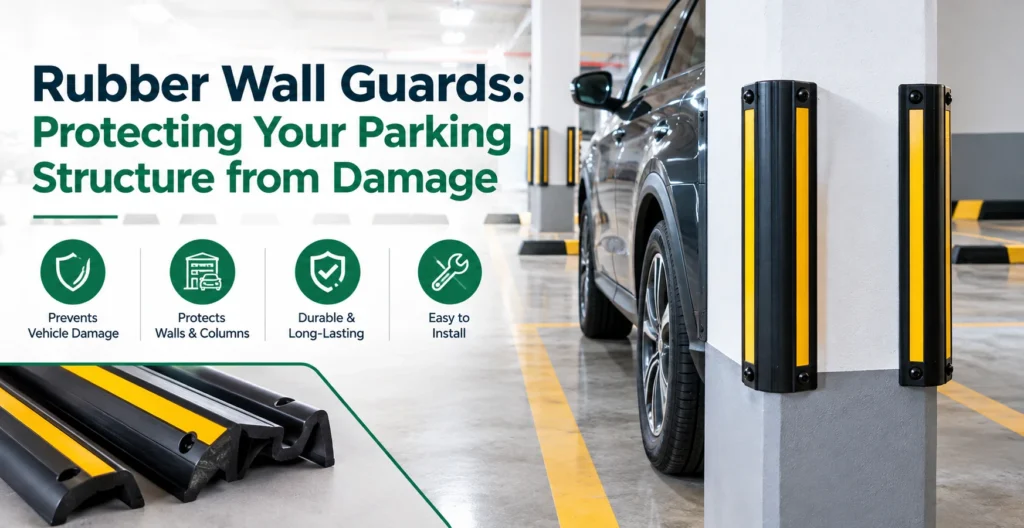
Rubber Wall Guards: Protecting Your Parking Structure from Damage
A parking structure has to deal with more than moving vehicles. Every day, cars, vans, delivery vehicles, and other traffic move close to walls, pillars, corners, and other fixed surfaces. Even a small mistake while turning or parking can leave scratches on a vehicle or damage the structure.
This is where rubber wall guards can provide a practical layer of protection.
Designed for areas where vehicles operate close to fixed surfaces, rubber wall guards help create a protective barrier between vehicles and vulnerable parts of a parking facility. Techno-Inn includes Rubber Wall Guards in its parking equipment range and states that they are used to protect vehicles, walls, and columns in parking lots, traffic areas, and service areas.
What Are Rubber Wall Guards?
Rubber wall guards are protective products installed on walls, columns, corners, or other exposed surfaces where vehicles may come into contact with them.
Their purpose is straightforward: create a protective layer at points that are vulnerable to accidental vehicle contact.
In a busy parking facility, drivers may have limited space when turning into a parking bay or navigating around columns. A protective guard can help reduce direct contact between the vehicle and the fixed surface.
Techno-Inn offers Rubber Wall Guards as part of its parking equipment category. The company identifies several forms on its product page, including corner rubber wall guards, round rubber wall guards, heavy-duty rubber wall guards, parking wall guards, rubber wall edge guards, and rubber wall safety guards.
Why Do Parking Structures Need Wall Protection?
Parking structures are exposed to repeated vehicle movement.
A driver may misjudge the distance while reversing. Another vehicle may take a turn too closely. A delivery vehicle may need to pass through a narrow service area. Over time, these situations can result in repeated contact with walls and columns.
The resulting damage can range from minor marks to more noticeable impact damage.
There is another side to the problem as well: vehicles can also be damaged.
A concrete column or wall does not move when a vehicle comes into contact with it. A protective guard provides an additional layer between the two surfaces.
This makes wall protection particularly useful in areas where vehicle movement occurs close to structural surfaces.
How Rubber Wall Guards Help Reduce Damage
The main purpose of a rubber wall guard is to provide protection at vulnerable contact points.
Consider a parking bay positioned beside a concrete column. Drivers have to judge their distance from the column while entering and leaving the space. If the vehicle gets too close, the column can become a point of contact.
A wall guard placed at an appropriate location can act as a protective buffer.
The same principle applies to corners and wall edges. These areas can be especially exposed because they present a concentrated contact point rather than a broad flat surface.
Rubber wall guards can therefore be incorporated into parking layouts where there is a clear risk of vehicle-to-structure contact.
They are not a substitute for careful driving, suitable parking design, lighting, or traffic management. Instead, they form one part of a broader parking-safety strategy.
Common Areas Where Wall Guards Can Be Used
Rubber wall guards are not limited to conventional parking bays.
Techno-Inn specifically identifies parking lots, traffic areas, and service areas as applications for its Rubber Wall Guards.
Depending on the layout of a facility, suitable locations may include:
1. Parking Bays Near Walls
Parking spaces positioned directly beside walls can expose both vehicles and the wall surface to accidental contact.
A wall guard can provide protection at these high-risk points.
2. Concrete Columns
Columns are common in multi-level and enclosed parking facilities. Their position can sometimes make them difficult for drivers to judge while turning or reversing.
Protecting exposed column surfaces can help reduce the consequences of minor vehicle contact.
3. Tight Turning Areas
Some parking structures have limited room for vehicles to maneuver. Corners and walls along these routes can become vulnerable to accidental contact.
Strategically placed guards can provide additional protection in these locations.
4. Service Areas
Service areas often experience a different type of vehicle movement from ordinary parking bays. Delivery vehicles, maintenance vehicles, and other traffic may operate close to walls and structures.
Techno-Inn lists service areas among the applications for its Rubber Wall Guards.
5. Wall Corners and Edges
Corners can be particularly vulnerable because even a small contact can produce visible damage to both the vehicle and the surface.
Corner and edge guard designs can be considered where these locations require additional protection.
Types of Rubber Wall Guards
Not every area presents the same protection challenge.
Techno-Inn’s Rubber Wall Guards product page shows several different forms of wall protection, including:
- Corner Rubber Wall Guards
- Round Rubber Wall Guards
- Heavy-Duty Rubber Wall Guards
- Parking Wall Guard Rubber
- Rubber Wall Edge Guards
- Rubber Wall Safety Guards
The right configuration should depend on the shape of the surface, the location of the guard, available clearance, and the type of vehicle traffic using the area.
For example, a column may require a different arrangement from a straight wall edge. Likewise, a vulnerable corner may need a guard specifically suited to its geometry.
Rather than choosing a product based only on appearance, facility managers should first identify where vehicle contact is most likely to occur.
Benefits of Using Rubber Wall Guards
Protection for Building Surfaces
Parking structures can experience repeated minor impacts over their operating life. Wall guards can provide additional protection to walls and columns at exposed locations.
Added Protection for Vehicles
The purpose is not only to protect the building. Techno-Inn states that its Rubber Wall Guards are used for protection of vehicles as well as walls and columns.
Useful in Busy Traffic Areas
Parking facilities are constantly changing environments. Different drivers use the same spaces throughout the day, increasing the importance of protecting vulnerable areas.
Practical for Service Locations
Service areas can have frequent vehicle movement and limited maneuvering space. Wall protection can be useful where vehicles operate close to fixed surfaces.
Different Designs for Different Locations
The availability of corner, round, heavy-duty, edge, and other guard forms means wall protection can be considered according to the characteristics of the location rather than using one identical arrangement everywhere.
Rubber Wall Guards vs. Other Parking Safety Equipment
Rubber wall guards are only one component of a properly planned parking environment.
Techno-Inn’s parking equipment category also includes Car Stoppers, Road Marking, Speed Breakers, Cat Eyes, Aluminium Studs, Road Signs, Traffic Cones, Curve Stones, Q-Stands, and Poles.
These products serve different purposes.
|
Parking Equipment |
Main Purpose |
|
Rubber Wall Guards |
Protect vehicles, walls, and columns |
|
Car Stoppers |
Help define vehicle stopping positions |
|
Road Marking |
Organize and guide vehicle or pedestrian movement |
|
Speed Breakers |
Help control vehicle speed |
|
Traffic Cones |
Provide temporary traffic guidance or separation |
|
Road Signs |
Communicate directions, warnings, or instructions |
|
Cat Eyes |
Improve visibility of road or parking markings |
|
Aluminium Studs |
Provide visible physical markers in traffic areas |
This distinction is important. Installing a wall guard does not replace the need for appropriate markings or speed management.
A well-planned facility uses different measures according to the specific risks present at each location.
What Should You Consider Before Installation?
Before installing rubber wall guards, examine how vehicles actually move through the area.
Identify Vulnerable Points
Look for walls, corners, columns, and edges that show signs of repeated contact or are positioned particularly close to vehicle paths.
Consider Vehicle Movement
A passenger car and a larger service vehicle may have very different turning and maneuvering requirements.
The protection arrangement should reflect the traffic using the space.
Check Available Clearance
A guard should be positioned so that it protects the intended surface without creating an unnecessary obstruction.
Look at the Entire Parking Layout
Wall protection works best as part of an overall parking-management plan.
Consider markings, signs, stopping points, speed control, visibility, and pedestrian movement alongside structural protection.
Choose the Appropriate Guard Design
Techno-Inn lists several Rubber Wall Guard variations. The shape and type of protection should be matched to the surface and location where it will be installed.
Why Wall Protection Matters for Facility Management
Damage prevention is easier to manage when vulnerable areas are identified before repeated impacts become a larger maintenance problem.
A parking structure is a shared environment. Drivers want enough room to maneuver without damaging their vehicles, while property managers need to maintain walls, columns, and other surfaces.
Wall guards can help address both concerns at locations where accidental contact is a realistic possibility.
They also fit naturally into a wider parking-safety approach. Techno-Inn’s website places Rubber Wall Guards alongside other parking products, including car stoppers, road markings, speed breakers, traffic cones, road signs, and related equipment.
The objective is not simply to add more equipment. It is to use the right equipment where it solves a specific problem.
Final Thoughts
Parking structure damage does not always come from major accidents. Repeated low-speed contact, tight turns, and small parking mistakes can gradually affect both vehicles and building surfaces.
Rubber wall guards offer a simple way to add protection at vulnerable locations.
Techno-Inn lists Rubber Wall Guards for the protection of vehicles, walls, and columns in parking lots, traffic areas, and service areas. Its product range includes different guard forms intended for various wall, corner, edge, and parking applications.
For facility owners and managers, the key is to identify the areas most exposed to vehicle contact and select protection that fits the site’s layout and traffic conditions.
When combined with suitable parking markings, stopping controls, signs, speed-management measures, and good site planning, structural protection can contribute to a more organized and better-protected parking environment.
FAQs
1. What are rubber wall guards used for?
Rubber wall guards are used to protect vehicles, walls, and columns from accidental contact in areas such as parking lots, traffic areas, and service areas. Techno-Inn specifically lists these applications on its product page.
2. Where can rubber wall guards be installed?
They can be considered for vulnerable walls, columns, corners, edges, parking areas, traffic areas, and service areas where vehicles operate close to fixed surfaces.
3. Does Techno-Inn offer different types of rubber wall guards?
Yes. Techno-Inn’s product page shows corner, round, heavy-duty, parking, edge, and safety guard variations.
4. Can rubber wall guards protect vehicles as well as walls?
Yes. According to Techno-Inn, its Rubber Wall Guards are used for the protection of vehicles, walls, and columns.
5. Are rubber wall guards enough to make a parking structure safe?
No. They address protection at vehicle-to-structure contact points. Other aspects of parking safety, such as appropriate markings, signs, speed control, visibility, traffic management, and site design, may also be required.
6. Are wall guards useful around parking columns?
They can be useful where columns are exposed to potential vehicle contact. The appropriate guard type and placement should depend on the column’s shape, location, clearance, and vehicle movement.
7. What other parking equipment does Techno-Inn provide?
Techno-Inn’s parking equipment range includes Rubber Wall Guards along with car stoppers, road marking, speed breakers, cat eyes, aluminium studs, road signs, traffic cones, curve stones, Q-stands, and poles.
8. How can I choose the right wall guard?
Start by identifying the surface that needs protection, the likely direction of vehicle movement, available clearance, and the type of traffic using the area. From there, select a guard design appropriate to the location.
Protect Your Parking Area with the Right Equipment
A parking structure works better when vehicle movement and vulnerable building surfaces are considered together.
If your facility needs protection around walls, columns, corners, or other exposed areas, explore Techno-Inn’s Rubber Wall Guards and its wider range of parking equipment.
For project-specific requirements, Techno-Inn also provides a Contact Us option for further information.