A perimeter fence is often the first physical boundary between a property and the outside world. But when ordinary fencing is not enough, additional protection may be needed along the boundary.
This is where razor wire and barbed wire come into consideration.
Both products are listed by Techno-Inn under its Physical Security Equipment range. However, they are not identical products, and the differences in their construction, available configurations and intended placement can influence which one makes more sense for a particular project.
The better choice is therefore not simply the product with the more intimidating name. It depends on what the perimeter needs to achieve and how the wire will be incorporated into the existing boundary.
Razor Wire vs Barbed Wire: The Basic Difference
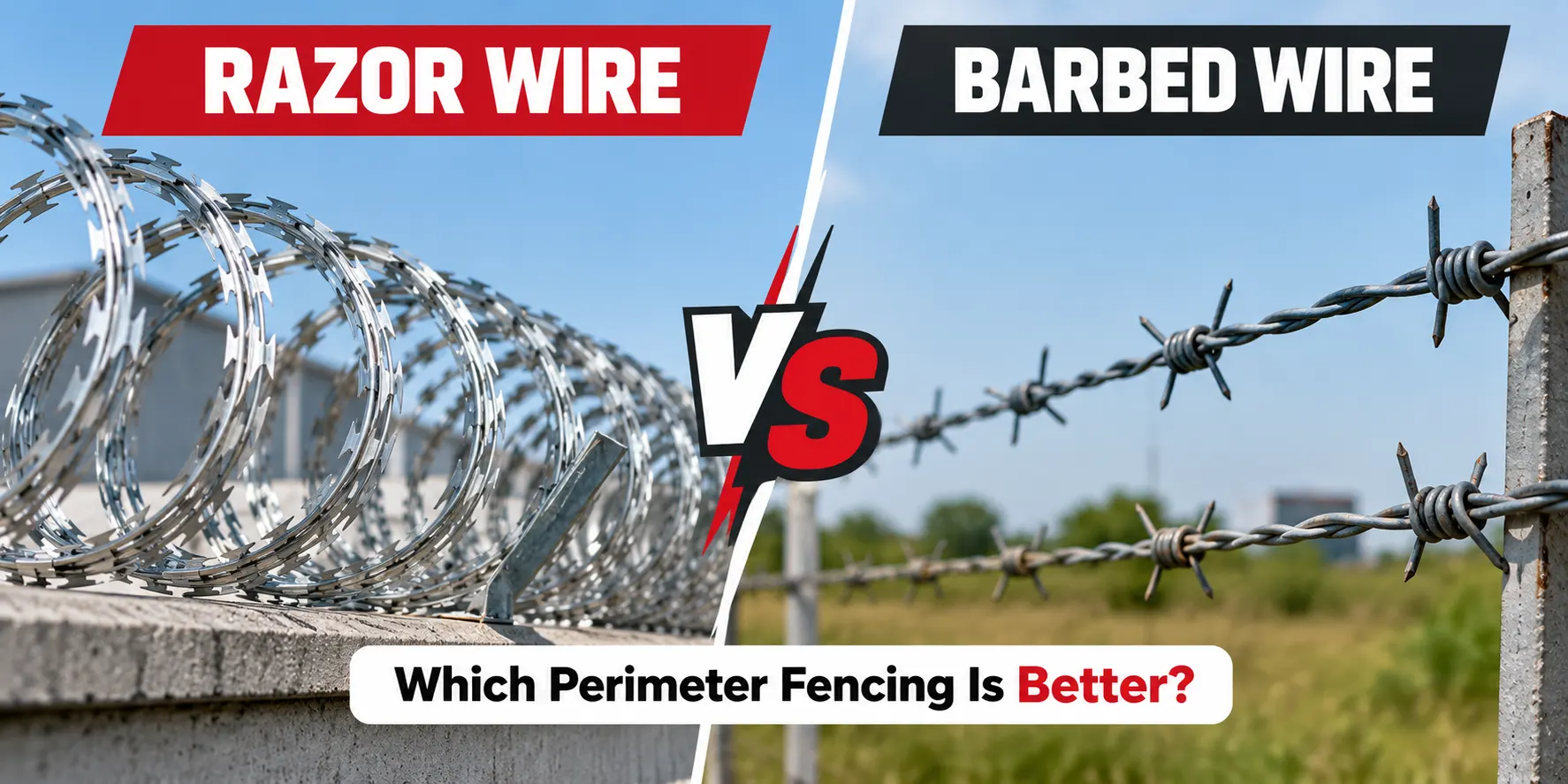
The easiest way to distinguish the two is by looking at how they are made.
Barbed wire uses pointed barbs positioned along strands of steel wire. Techno-Inn describes it as a fencing material that can also be used above walls around secured properties.
Razor wire uses sharp-edged ribbon and is offered in different configurations. Techno-Inn’s razor-wire page shows applications involving boundary fencing and installation on walls for factory or residential fencing.
So while both products are intended to make unauthorised passage more difficult, their physical construction is different.
What Techno-Inn Says About Razor Wire
Techno-Inn lists Razor Wire as a dedicated product within its physical security equipment category. Its current page shows several forms, including barbed razor wire, razor wire fencing, spiral rolls, cross type razor wire and boundary-wall applications.
The company also states that different outer diameters can be supplied. The page gives 800 mm and 900 mm as examples for border-line fencing and mentions 500 mm for civilian use.
Another specification shown on the page is galvanized steel razor wire with an 18-inch diameter. The page also mentions razor ribbon for chain link fencing and states that each roll covers 50 linear feet.
These details are useful when planning a project because razor wire is not presented as one fixed configuration.
What Techno-Inn Says About Barbed Wire
Barbed wire is also listed separately by Techno-Inn.
The company’s product information describes several ways the product can be specified. These include different materials, strand arrangements, barb designs and twisting methods.
That gives buyers more to consider than simply choosing between a standard roll and a heavier roll.
For example, Techno-Inn identifies:
- Zinc coated steel wire
- Zinc aluminium alloy-coated steel wire
- Polymer coated steel wire
- Stainless steel wire
The page also lists single and double strand structures.
Barbed Wire Has Multiple Configurations
One of the useful points on Techno-Inn’s barbed wire page is the range of configurations it identifies.
Strand Arrangement
The site distinguishes between single strand and double strand construction.
A single strand arrangement uses one line wire with barbs, while the double strand version uses two line wires with the barbs.
Barb Arrangement
Techno-Inn also identifies single barb and double barb versions.
The company associates these with two point and four point barbed wire configurations respectively.
Twisting Method
The website further describes two twisting approaches:
- Conventional twist
- Reverse twist
These differences mean that a buyer should identify the required construction before ordering rather than treating every barbed-wire product as interchangeable.
Where Does Techno-Inn Position Razor Wire?
According to the current Razor Wire page, Techno-Inn identifies several perimeter-related uses.
The page mentions border fencing, along with installation on walls for factory fencing and residence fencing.
This makes razor wire relevant to projects where the wire forms part of an existing boundary rather than necessarily being considered as a standalone fence.
The website also displays different razor wire formats, including spiral and cross type arrangements.
Where Does Techno-Inn Position Barbed Wire?
Techno-Inn describes barbed wire as suitable for constructing fences and for placement on top of walls surrounding secured property.
That makes it particularly relevant when a project already has a boundary structure and needs additional physical protection along it.
The website also describes barbed wire as relatively straightforward to erect, referring to fence posts, wire and fixing devices as the basic components involved in its construction.
Which One Provides the Better Perimeter Solution?
There is no single answer for every property.
Razor wire may be the more suitable option when a project calls specifically for the type of razor wire configurations and perimeter applications described by Techno-Inn.
Barbed wire may be preferable when the project calls for a conventional wire barrier and the available material and structural variations fit the boundary requirements.
The important point is that “better” should be decided according to the installation, not simply by comparing the names of the two products.
A Side-by-Side Look
| Factor | Razor Wire | Barbed Wire |
| Listed by Techno-Inn | Yes | Yes |
| Product category | Physical Security Equipment | Physical Security Equipment |
| Construction | Razor-edged ribbon | Wire strands with pointed barbs |
| Configurations shown by Techno-Inn | Spiral, cross-type and other razor-wire forms | Single/double strand, single/double barb and different twists |
| Material information on Techno-Inn page | Galvanized steel is specified | Zinc-coated, zinc-aluminium, polymer-coated and stainless steel options |
| Boundary use mentioned | Border fencing and walls | Fences and tops of secured walls |
| Diameter information | Different outer diameters are offered | Not presented in the same diameter format on the page |
| Roll information | 50 linear feet per roll is stated | No equivalent roll coverage figure is stated on the page |
The table reflects information currently published on Techno-Inn’s individual product pages rather than assumptions about products from other manufacturers.
What Should You Consider Before Choosing?
Choosing perimeter wire is easier when the decision starts with the site rather than the product catalogue.
1. Look at the Existing Boundary
Is the wire going onto a wall, chain-link fence or another type of perimeter?
This matters because Techno-Inn specifically describes razor ribbon for chain link fencing and mentions wall applications for razor wire. Its barbed-wire page also identifies use above secured walls.
2. Decide What Configuration You Need
With barbed wire, Techno-Inn lists several structural choices. The same principle applies to razor wire, where the company presents different forms and outer diameters.
Knowing the intended installation before purchasing can therefore prevent an unsuitable product selection.
3. Consider the Material
For barbed wire, Techno-Inn identifies several material choices, including galvanized steel, zinc aluminium alloy coated steel, polymer coated steel and stainless steel.
For razor wire, the website specifically identifies galvanized steel in its listed product information.
4. Consider the Whole Security Arrangement
Perimeter wire is only one part of physical security.
Techno-Inn’s wider product range includes electric fences, road blockers, road barriers, tyre killers, under vehicle surveillance systems and entry gates.
For a larger facility, the boundary may therefore need to work alongside other security measures.
Razor Wire or Barbed Wire for a Boundary Wall?
This is one of the areas where the Techno-Inn website gives useful information for both products.
For razor wire, the company mentions installation on walls for factory and residence fencing.
For barbed wire, Techno-Inn says it can be used on top of walls surrounding secured property.
Therefore, both products can be relevant to wall-based perimeter protection, but they should not be treated as identical solutions.
The final choice should take account of the wall design, the required configuration and the property’s security needs.
Does One Cost Less?
Techno-Inn’s current product pages do not publish a direct price comparison between razor wire and barbed wire.
For that reason, it would be misleading to claim that one is always cheaper.
The final project cost can depend on the selected configuration, material, quantity and installation requirements. If a particular project requires pricing, the appropriate approach is to request a quotation based on the actual perimeter requirements.
Why Product Specifications Matter
A common mistake is to ask for “security wire” without defining what is actually needed.
Techno-Inn’s own product pages demonstrate why that approach can create confusion.
Its barbed-wire page includes multiple materials and construction options, while its razor-wire page provides different outer-diameter choices and several product forms.
A better purchasing conversation should therefore include details such as:
- Type of wire required
- Existing boundary structure
- Approximate perimeter length
- Desired configuration
- Material requirements
- Intended installation location
This gives the supplier enough information to recommend an appropriate product rather than supplying a generic option.
Final Verdict: Razor Wire vs Barbed Wire
If the question is “Which one is better?”, the honest answer is: it depends on the perimeter.
Choose based on the requirements of the property, not simply on which product appears more secure.
Razor wire is worth considering when the project calls for razor wire fencing, spiral or cross-type configurations, or the wall and border applications identified by Techno-Inn. The company also provides different outer diameter options.
Barbed wire offers a different approach, with Techno-Inn listing several material choices as well as single and double strand, single and double barb and different twist configurations.
For a property owner or security planner, the best starting point is therefore to assess the boundary and specify the actual requirements before deciding between the two.
Frequently Asked Questions
Is razor wire available from Techno-Inn?
Yes. Techno-Inn lists Razor Wire as a product under its Physical Security Equipment category and has a dedicated product page for it.
Does Techno-Inn also offer barbed wire?
Yes. Barbed Wire is separately listed under the same physical security category.
What razor-wire diameters does Techno-Inn mention?
The current product page states that different outer diameters are available. It gives 800 mm and 900 mm as general examples for border-line fencing and 500 mm as an example for civilian use.
How much area does one razor-wire roll cover?
Techno-Inn’s Razor Wire page states that each roll covers 50 linear feet.
What materials are available for Techno-Inn’s barbed wire?
The website identifies zinc-coated steel, zinc aluminium alloy coated steel, polymer coated steel and stainless steel options.
Does Techno-Inn offer different barbed-wire designs?
Yes. Its page identifies single and double strand structures, single and double barb arrangements and conventional and reverse twists.
Can both products be used around walls?
Techno-Inn’s product information mentions razor wire for wall applications involving factories and residences and barbed wire on top of walls surrounding secured properties.
Making the Right Perimeter Choice
Razor wire and barbed wire can both form part of a physical security strategy, but selecting between them should be based on the actual site.
Start by examining the existing boundary, determine the required configuration and identify how the perimeter protection will fit with the rest of the property’s security system.
Techno-Inn provides both Razor Wire and Barbed Wire, along with other physical security equipment, so the right product can be selected according to the requirements of the project.