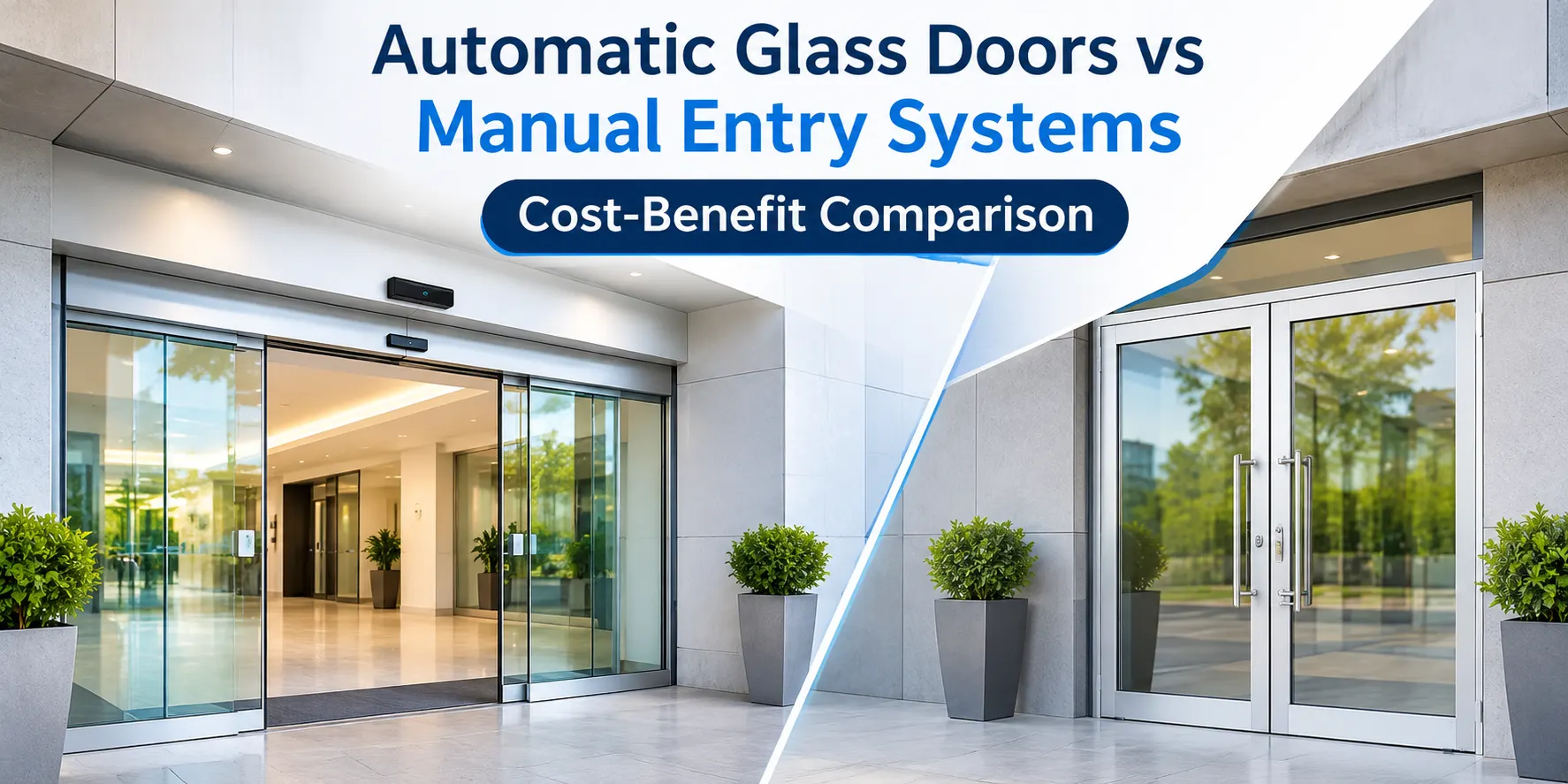
Choosing the right entrance system for a commercial building is an important decision that affects accessibility, security, energy efficiency, customer experience, and long-term operating costs. When comparing automatic glass doors vs manual entry systems, business owners need to consider more than the initial purchase and installation expenses.
Automatic glass doors offer hands-free access, modern aesthetics, and convenient pedestrian movement. Manual entry systems, on the other hand, are generally simpler to install, operate, and maintain.
Both options have advantages, but the right choice depends on the building’s purpose, daily pedestrian traffic, budget, and operational requirements.
For businesses in Pakistan, particularly shopping malls, hospitals, corporate offices, hotels, and retail stores, understanding the cost-benefit differences can help determine which entrance solution provides better long-term value.
In this guide, we compare automatic and manual glass doors based on installation costs, maintenance, energy efficiency, accessibility, safety, and return on investment.
What Are Automatic Glass Doors?
Automatic glass doors are entrance systems that open and close automatically when a person approaches or activates an approved control device.
These doors typically use motion or presence sensors, electronic controllers, motors, and mechanical drive systems to manage movement.
Automatic entrance systems are commonly installed in commercial buildings where convenient access and efficient pedestrian flow are important.
Common Types of Automatic Glass Doors
Automatic Sliding Glass Doors
These doors move horizontally along a track and are commonly used in shopping malls, hospitals, hotels, and commercial entrances.
Automatic Swing Glass Doors
Automatic swing doors use a powered operator to open and close a hinged door. They can be useful where a sliding entrance is not practical.
Telescopic Automatic Sliding Doors
Telescopic systems use multiple sliding panels to create a wider opening within a limited installation space.
Automatic Sensor Glass Doors
These doors use compatible sensors to detect approaching pedestrians and activate the opening mechanism.
The appropriate design depends on the entrance dimensions, pedestrian traffic, accessibility requirements, and building layout.
What Are Manual Entry Systems?
Manual entry systems are doors that require a person to physically open and close them.
Common examples include hinged glass doors, manually operated sliding doors, and other conventional commercial entrance doors.
Manual doors usually have fewer mechanical and electronic components than automatic systems.
They may include:
- Door handles
- Hinges or sliding tracks
- Mechanical locks
- Door closers
- Floor springs
- Safety glass panels
- Suitable frames and fittings
Manual glass doors are commonly used in small offices, retail shops, restaurants, and commercial buildings with relatively low pedestrian traffic.
Although manual doors can be economical, they may become less convenient in high-traffic environments or where hands-free access is important.
Automatic Glass Doors vs Manual Entry Systems: Key Differences
Understanding the differences between automatic and manual entry systems helps businesses evaluate both immediate and long-term requirements.
| Feature | Automatic Glass Doors | Manual Entry Systems |
| Operation | Sensor or control activated | Hand operated |
| Initial Investment | Generally higher | Generally lower |
| Installation | Requires electrical and mechanical setup | Usually simpler |
| Accessibility | Hands-free operation | Depends on door design and hardware |
| Pedestrian Flow | Convenient for frequent traffic | Suitable for lighter traffic |
| Electricity | Usually required | Usually not required for basic operation |
| Maintenance | Sensors, motors, controllers, and mechanical parts | Hinges, closers, locks, and fittings |
| Energy Efficiency | Controlled opening and closing | Depends on user behavior and door closers |
| Security | Can integrate with compatible electronic systems | Primarily mechanical, with optional electronic hardware |
| Best Applications | Hospitals, malls, hotels, busy offices | Small offices, shops, low-traffic entrances |
Neither option is automatically better for every building. The most suitable entrance depends on usage patterns, accessibility needs, safety requirements, and the total cost of ownership.
1. Initial Installation Cost Comparison
One of the biggest differences between automatic glass doors and manual entry systems is the initial investment.
Automatic Glass Door Installation Cost
Automatic glass door systems generally require more equipment than conventional manual doors.
A typical automatic entrance installation may include:
- Safety glass panels
- Door frame and track
- Motorized operator
- Electronic controller
- Motion and presence sensors
- Safety detection equipment
- Electrical connections
- Opening and closing controls
- Professional installation and commissioning
The total cost depends on the selected door type, opening dimensions, glass specifications, automation equipment, and site conditions.
Automatic sliding glass doors may also require structural preparation and adequate space for the moving panels.
Manual Glass Door Installation Cost
Manual entry systems generally require fewer electronic components.
Installation may involve:
- Glass door panels
- Hinges or sliding hardware
- Handles and locks
- Door closers or floor springs
- Suitable frames
- Mechanical adjustments
Because manual systems usually do not require a motorized operator, their initial installation cost is often lower.
Which Option Is More Cost-Effective Initially?
For businesses with limited budgets and low pedestrian traffic, manual glass doors may offer better initial affordability.
However, buildings with frequent visitor movement may benefit from the convenience and operating features of automatic entrance systems.
2. Automatic Glass Door Price in Pakistan
The automatic glass door price in Pakistan varies according to the door’s size, operating mechanism, glass type, automation components, and installation requirements.
There is no single price that applies to every commercial entrance.
Factors Affecting Automatic Glass Door Prices
Door Size and Configuration
Larger entrances may require additional glass panels, stronger operators, and more extensive mounting arrangements.
Glass Type
Tempered, laminated, and other specified safety glazing options may have different costs.
Motor and Controller
The operator’s capacity, control functions, and manufacturer specifications influence equipment selection.
Sensor Technology
Motion sensors, presence detection, and additional safety devices can affect the system configuration.
Installation Complexity
Electrical preparation, structural adjustments, and integration requirements may contribute to the total installation cost.
Additional Features
Access control integration, operating modes, backup power, and other compatible options can influence the quotation.
Businesses should compare quotations based on equivalent specifications rather than choosing solely by the lowest initial cost.
For project-specific requirements, contact Techno-Inn to discuss suitable entrance automation solutions.
3. Maintenance and Long-Term Operating Costs
Maintenance is an important consideration when comparing automatic glass doors vs manual entry systems.
Automatic Glass Door Maintenance
Automatic doors contain electronic and mechanical components that require regular inspection.
Maintenance may include:
- Sensor cleaning and testing
- Motor and drive inspection
- Track and roller maintenance
- Door alignment
- Controller diagnostics
- Safety detection testing
- Electrical connection inspection
- Replacement of worn components
A properly maintained automatic door can provide reliable service, but repairs may require specialized technicians and replacement parts.
Manual Glass Door Maintenance
Manual doors generally have fewer electronic components.
Typical maintenance includes:
- Hinge inspection
- Handle and lock servicing
- Door closer adjustment
- Floor spring maintenance
- Glass fitting inspection
- Door alignment
Although manual doors often have lower servicing complexity, frequently used doors can still experience significant wear.
Long-Term Cost Comparison
Automatic doors may have higher maintenance expenses because of their motors, sensors, controllers, and other specialized components.
Manual doors often have simpler maintenance requirements.
However, the actual cost depends on usage frequency, equipment quality, installation conditions, and preventive maintenance.
4. Energy Efficiency: Which Entrance System Performs Better?
Energy efficiency is another important factor for commercial buildings using air conditioning or heating.
Entrance doors affect how much conditioned indoor air escapes when people enter or leave.
Energy Efficiency of Automatic Glass Doors
Automatic glass doors open when activated and close after the configured operating period, subject to safety detection.
This controlled operation can reduce unnecessary door-open time compared with manual doors that are frequently left open.
Automatic doors may be particularly useful in:
- Air-conditioned shopping malls
- Hotels
- Hospitals
- Corporate offices
- Busy retail entrances
However, automatic doors can also open frequently in high-traffic locations, which may increase air exchange.
Their energy performance depends on sensor settings, door speed, opening width, pedestrian traffic, and building conditions.
Energy Efficiency of Manual Doors
Manual doors do not normally consume electricity for basic opening and closing.
When fitted with properly adjusted door closers, they can also help limit unnecessary air exchange.
However, users may leave manual doors open, especially during busy periods.
Which Is More Energy-Efficient?
Automatic doors may reduce unnecessary open time in some commercial environments, while manual doors may perform well in lower-traffic buildings.
Actual energy savings should be assessed using the building’s traffic patterns, climate control system, entrance design, and operating conditions.
5. Accessibility and Customer Convenience
Accessibility is one of the strongest reasons businesses consider automatic entrance doors.
Benefits of Automatic Glass Doors
Automatic doors can provide hands-free entry for:
- Wheelchair users
- People using mobility aids
- Elderly visitors
- Parents with strollers
- Customers carrying shopping bags
- Staff transporting equipment
They can also make movement more convenient during busy periods.
However, automatic operation alone does not guarantee accessibility. Clear opening width, thresholds, approach space, detection coverage, and other requirements must comply with applicable accessibility standards.
Manual Door Accessibility
Manual doors can also be accessible when designed with suitable hardware, opening forces, dimensions, and clearances.
However, heavy doors or difficult-to-operate handles may create challenges for some users.
Which Option Offers Better Convenience?
Automatic glass doors often provide a more convenient entrance experience in high-traffic commercial settings.
Manual doors may remain suitable where pedestrian traffic is limited and accessibility requirements can be met through an appropriate design.
6. Security Comparison: Automatic vs Manual Glass Doors
Security is an important consideration when selecting a commercial entrance system.
Both automatic and manual doors can support secure access when paired with suitable locking and monitoring arrangements.
Automatic Glass Door Security Features
Depending on the system, automatic doors may support:
- Electronic locking
- RFID access control
- Biometric authentication
- Remote operating controls
- Scheduled operating modes
- Door status monitoring
- Integration with compatible security systems
These features can be useful for offices, hospitals, and commercial facilities that need controlled access during selected hours.
For related solutions, explore Techno-Inn’s Access Control Systems.
Manual Glass Door Security
Manual doors may use mechanical locks, compatible electronic locks, and other security hardware.
Their security performance depends on the door construction, glass, frame, locking mechanism, and installation quality.
Which System Is More Secure?
Neither automatic nor manual operation alone determines security.
A secure entrance requires appropriate glazing, locking hardware, access policies, and safe exit arrangements.
Where a door forms part of a required emergency escape route, the security design must not compromise compliant emergency egress.
7. Safety Features and Emergency Operation
Commercial entrance doors should be selected with occupant safety in mind.
Automatic Glass Door Safety
Suitable automatic door systems may incorporate:
- Presence detection sensors
- Obstruction detection
- Controlled opening and closing speeds
- Safety monitoring
- Manual release or emergency operating modes
- Breakout features on approved configurations
The required safety features depend on the door type, location, and applicable standards.
Manual Glass Door Safety
Manual doors may include:
- Safety glazing
- Suitable door closers
- Appropriate hinges
- Safe handles
- Controlled opening movement
- Compatible emergency exit hardware
Emergency Exit Requirements
Automatic and manual doors used on required escape routes must comply with the applicable building and fire safety requirements.
For related building safety information, read about Emergency Exit Doors in Pakistan.
8. Durability and Daily Performance
The durability of an entrance system depends on its construction quality, installation, usage, and maintenance.
Automatic Glass Doors
Automatic systems can provide consistent opening and closing cycles when correctly specified and maintained.
They are often selected for locations with frequent pedestrian movement.
However, sensors, motors, rollers, and controllers require periodic inspection.
Manual Glass Doors
Manual doors generally have simpler operating mechanisms.
They may be practical for smaller facilities where daily usage is relatively low.
However, high-frequency use can cause wear to hinges, handles, closers, and other mechanical components.
Which Lasts Longer?
There is no universal winner.
A well-installed and maintained automatic system may perform reliably for many years, while a quality manual door can also offer long service life.
The appropriate choice depends on traffic volume, hardware quality, environmental conditions, and maintenance practices.
9. Automatic Glass Doors vs Manual Entry Systems: Cost-Benefit Analysis
A useful comparison considers both the initial investment and the expenses incurred throughout the door’s operating life.
| Cost or Benefit | Automatic Glass Doors | Manual Entry Systems |
| Initial Equipment Cost | Higher in many cases | Lower in many cases |
| Installation Complexity | Higher | Lower |
| Electricity Consumption | Requires power for operation | Usually minimal for basic doors |
| Maintenance Complexity | More specialized | Generally simpler |
| Accessibility Convenience | Strong advantage for hands-free access | Depends on design |
| Pedestrian Flow | Convenient for frequent traffic | Practical for lower traffic |
| Electronic Integration | Often supports advanced options | Possible with suitable hardware |
| Energy Management | Controlled closing may help | Door closers may help |
| Customer Experience | Modern, convenient entrance | Simple, familiar operation |
| Long-Term Value | Depends on operational benefits | Depends on usage and requirements |
Understanding Total Cost of Ownership
Instead of comparing only purchase prices, calculate the estimated total cost over a chosen period.
Total Cost of Ownership = Initial Equipment + Installation + Electricity + Maintenance + Repairs + Replacement Costs
For a meaningful comparison, use the same evaluation period for both systems.
For example, a business could compare the expected costs over five years using supplier quotations, estimated usage, electricity tariffs, and maintenance schedules.
How to Estimate Return on Investment
Automatic glass doors may provide operational benefits through improved accessibility, easier pedestrian movement, and potentially reduced unnecessary door-open time.
A simple financial evaluation can use:
Net Financial Benefit = Estimated Operating Savings − Additional Ownership Costs
ROI (%) = (Net Financial Benefit ÷ Additional Initial Investment) × 100
Only measurable financial savings should be included in the calculation. Improved customer convenience and accessibility are valuable benefits, but they should not be presented as guaranteed monetary returns.
10. Which Entrance System Is Best for Different Businesses?
The most suitable entrance system depends on the building’s traffic volume, accessibility needs, and operating conditions.
Shopping Malls
Automatic sliding glass doors are often a practical choice for busy mall entrances because they support hands-free movement and frequent pedestrian traffic.
Hospitals and Healthcare Facilities
Automatic doors can improve accessibility for patients, wheelchair users, visitors, and staff moving equipment.
The selected system must meet relevant accessibility, safety, and healthcare facility requirements.
Corporate Offices
Automatic glass doors may be suitable for main reception entrances, while manual doors can remain practical for internal rooms and lower-traffic areas.
Hotels
Automatic entrance doors can provide convenient access for guests carrying luggage and support a modern entrance appearance.
Retail Stores
Busy retail outlets may benefit from automatic doors, while smaller shops with limited traffic may find manual doors sufficient.
Restaurants and Cafés
The choice depends on customer volume, available space, accessibility requirements, and the overall entrance design.
Industrial and Warehouse Facilities
Specialized entrance systems may be required depending on pedestrian movement, equipment traffic, and operational safety needs.
11. When Should You Upgrade from Manual to Automatic Glass Doors?
Replacing a manual entrance with an automatic system may be worth considering when:
- Customers frequently struggle to open the existing door.
- The entrance experiences heavy pedestrian traffic.
- Hands-free accessibility is an important requirement.
- Staff regularly transport goods or equipment through the entrance.
- The building needs improved entrance flow.
- Manual doors are frequently left open.
- The property is undergoing a commercial renovation.
- The entrance needs compatible electronic access control.
Before upgrading, review the opening dimensions, electrical requirements, structural conditions, safety standards, and installation feasibility.
12. How to Choose the Right Automatic Glass Door in Pakistan
Businesses planning to install automatic glass doors should consider several factors before selecting a system.
Entrance Dimensions
Measure the available opening width, height, and space required for moving door panels.
Pedestrian Traffic
Estimate normal and peak pedestrian movement to select a suitable operating mechanism.
Door Configuration
Choose between sliding, swing, or telescopic arrangements according to the available space and application.
Glass Specifications
Use suitable safety glazing that meets applicable building requirements.
Automation Equipment
Review the operator’s specifications, supported door weight, control functions, and maintenance requirements.
Safety Features
Confirm the required presence detection, obstruction protection, and emergency operating arrangements.
Security Integration
Determine whether the door needs to work with an RFID reader, biometric terminal, or other access control equipment.
Installation and Maintenance
Choose a suitable installation arrangement and confirm the availability of technical support and replacement components.
13. Why Choose Techno-Inn for Automatic Glass Door Solutions?
Techno-Inn provides security and entrance automation solutions for commercial and institutional applications in Pakistan.
Businesses planning an automatic entrance can discuss suitable configurations according to building layout, pedestrian traffic, and operating requirements.
Entrance Automation Solutions
Explore suitable automatic glass door configurations for commercial entrances.
Security System Integration
Discuss compatible electronic access control options for controlled entrances.
Project-Specific Requirements
Review entrance dimensions, door operation, safety features, and installation considerations.
Lahore-Based Inquiries
Customers in Lahore and other cities across Pakistan can contact Techno-Inn to discuss entrance automation requirements and available solutions.
For more information, visit the Techno-Inn website.
Frequently Asked Questions
1. Are automatic glass doors better than manual doors?
Automatic glass doors can offer greater convenience, hands-free access, and easier movement in high-traffic areas. Manual doors may be more economical and simpler to maintain in lower-traffic buildings.
2. What is the automatic glass door price in Pakistan?
The price depends on door dimensions, glass specifications, operator type, sensors, safety features, and installation requirements. Contact a supplier for a project-specific quotation.
3. Do automatic glass doors consume a lot of electricity?
Electricity consumption depends on the motor, controller, operating frequency, and standby requirements. The manufacturer’s power specifications should be used to estimate actual consumption.
4. Are automatic glass doors energy-efficient?
Automatic doors can help limit unnecessary open time through controlled operation, but actual energy performance depends on traffic, sensor settings, door configuration, and building conditions.
5. Can automatic glass doors work during a power failure?
Power-failure behavior depends on the system. Some configurations support backup power, manual operation, or other emergency functions. Required exit arrangements must be confirmed before installation.
6. Do automatic glass doors require regular maintenance?
Yes. Sensors, motors, tracks, rollers, controllers, and safety functions should be inspected and maintained according to manufacturer recommendations.
7. Can automatic glass doors integrate with access control systems?
Yes. Compatible automatic doors may work with RFID readers, biometric devices, and other approved electronic access control systems.
8. Are manual glass doors suitable for commercial buildings?
Yes. Manual glass doors may be suitable for offices, shops, restaurants, and other commercial buildings when they meet the relevant safety, accessibility, and operational requirements.
9. Which is more durable: automatic or manual glass doors?
Both can provide long service life when properly specified, installed, and maintained. Durability depends on construction quality, usage frequency, environmental conditions, and servicing.
10. Are automatic sliding glass doors suitable for hospitals?
Automatic sliding doors can support convenient movement for patients, staff, and visitors. The installation must meet applicable accessibility, safety, hygiene, and emergency exit requirements.
11. Can existing manual glass doors be converted into automatic doors?
Some existing entrances may be suitable for automation, but feasibility depends on door weight, frame condition, available space, hardware compatibility, and safety requirements. A site assessment is recommended.
12. Where can I inquire about automatic glass doors in Lahore?
You can contact Techno-Inn in Lahore, Pakistan, to discuss automatic glass door configurations, installation requirements, and available entrance automation solutions.
Conclusion: Automatic Glass Doors vs Manual Entry Systems – Which Offers Better Value?
When comparing automatic glass doors vs manual entry systems, the best choice depends on your building’s requirements rather than the initial purchase cost alone.
Automatic glass doors offer hands-free convenience, efficient pedestrian movement, accessibility benefits, and integration opportunities with modern security systems. They are particularly useful for busy commercial entrances, hospitals, hotels, and shopping malls.
Manual entry systems generally offer lower initial costs, simpler operation, and less complex maintenance. They can be a practical solution for smaller businesses and low-traffic entrances.
For businesses in Pakistan, evaluating installation requirements, ongoing maintenance, electricity consumption, safety, accessibility, and expected pedestrian traffic can help identify the most suitable option.
Planning to install automatic glass doors in Lahore or elsewhere in Pakistan?
Contact Techno-Inn to discuss your entrance requirements and explore suitable automation solutions.